
The expertise
Universal Long Fashion
Long-term sustainability
Designed to last
High-end craftsmanship
Timeless materials.

Flanelle de laine, haut de gamme, par un tisseur Italien de référence.


Flanelle de laine, haut de gamme, par un tisseur Italien de référence.
The fabric
Heroes deserve the very best! This is almost the starting point for this brand and its first collection: having worn a garment made from this fabric once and never wanting to part with it! A surprisingly soft feel and exceptional fluidity against the skin make this selection of fabrics from Vitale Barberis Canonico an irresistible asset. This iconic Italian weaver, established in 1663, has successfully preserved and adapted its expertise to the demands of our generation. By focusing on three key areas: people, the environment, and production. 100% Italian manufacturing, from the washing of the raw wool to the final finishing of the fabric. The origin of this natural raw material and all processing methods are designed to minimize the impact on the environment and on animal and human well-being. This precious fabric deserves care: - dry cleaning recommended - avoid machine washing - iron at a maximum of 150°C The cotton gabardines, velvets, and linens in the Hiatus collections come from the English weaver Brisbane Moss, which is also committed to sustainable practices.
The Fashion Drawing
The spontaneity of sketching in the service of our humanity! Seasons pass, yet the collections endure. While each collection comes to life at a specific moment in our history, every piece is designed to last. First, concepts shaped by the spirit of the times. References to the past and aspirations for the future combine to define a guiding vision. Then, the hand, the paper, and the pencil sketch out—moving from silhouette to silhouette around a central theme—a complete wardrobe for the man of today and tomorrow. Alongside the design, a range of fabrics and colors—sourced from historic European weavers—is introduced. They have been selected for their qualities (such as weight, drape, or structure, depending on the collection, and natural fibers) as well as their ability to age gracefully.
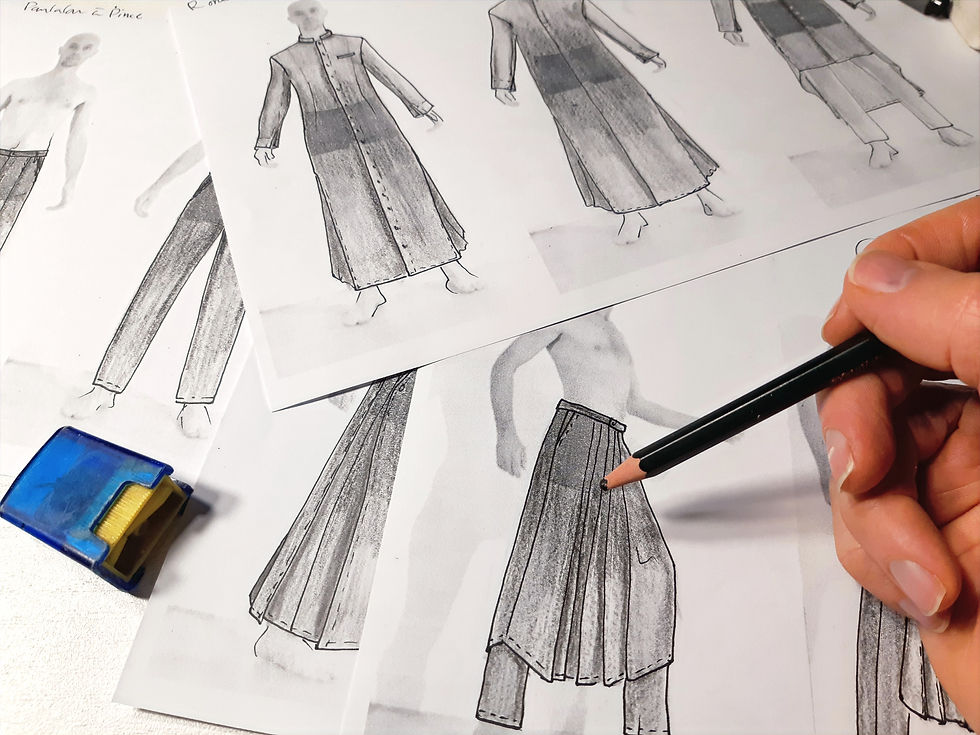


Pour réaliser les premiers prototypes de la collection Scottalian Mektoub


The Design
Patterns set in stone! Created using flat pattern cutting—a proven method used in high-end ready-to-wear fashion. Every construction detail is developed as a prototype before final approval. Pattern making and grading are performed by hand, upholding artisanal craftsmanship free from the vagaries of computer software.
The Garment Manufacturing
Grandson and great-grandson of master tailors! The scissors and sewing machine inherited from our forebears are still in use. In our fully self-sufficient workshop, you will find a cutting table where our fine fabrics are unrolled, a hot iron—essential for precision assembly—and the sewing machines where your garment takes shape. Each garment is crafted with the utmost care, specifically for you, following your order. There is no mass production, ensuring attention to every single seam.


The Photography
Purify the image to transcend trends! Although we inherited the camera body and lens belonging to our father and grandfather—a professional photographer—and used that equipment for the workshop photos, we shot the Scottalian Mektoub collection using a tool from the current generation: a mobile phone with 50-megapixel resolution, which is more than sufficient for web imagery. The images in this collection were therefore created with a focus on technical ease of use and setup. Operating independently within the living space of Espace Chandy, the yoga room is transformed into a temporary photo studio. With no models other than the design duo, no accessories—just light, the body, and the fabric. Philosophicum: Placing the human back at the center of clothing—viewing clothing as a way to honor singularity, and asserting that singularity as act to elevate the power of vulnerability. Inclusive sobriety of the human animal body in unique, unified actor.